Research and Findings
The following empirical research and theoretical scholarship examines two distinct domains: business analysis centers of excellence (BACoEs) (how they are structured, why they succeed, and why they fail) and persistent dysfunction in high-performing individuals through The Gap framework. This research addresses questions that consulting literature and methodology frameworks rarely examine with rigor. The BACoE research informs the frameworks in The Business of Analysis: How to Build, Launch, and Sustain a High-Performance Business Analysis Capability and extends them with evidence drawn from organizational practice. The Gap framework extends the consulting psychology and executive coaching literature with evidence drawn from clinical psychology and practitioner observation.
Research Foundation
Business Analysis Center of Excellence Research
This research program comprises studies drawing on mixed-methods designs. All studies employed case-based designs drawing on in-depth interviews, document analysis, and direct observation. Three studies employed longitudinal case designs ranging from 24 to 48 months, tracking cases at multiple points to observe developmental progression. Two studies employed extended observational case designs over 24 months, tracking cases chronologically to understand repositioning mechanisms and failure patterns. Three studies included survey components totaling 381 BACoE and business analysis function leaders, with one study additionally incorporating content analysis of 325 job postings. Organizational contexts span financial services, healthcare, technology, manufacturing, retail, insurance, and other sectors.
Studies employed quantitative methods including cluster analysis, hierarchical multiple regression, logistic regression, configurational analysis, and fuzzy-set Qualitative Comparative Analysis alongside qualitative methods including content analysis, pattern matching, process tracing, and the Gioia methodology. Findings consistently demonstrate that political factors outweigh technical capability in determining BACoE outcomes. This is a pattern that emerges independently across every study in this series.
Project Governance Research
This research examines whether structured business analysis engagement before project approval predicts investment decision quality, establishing Investment Decision Quality (IDQ) as an empirically measurable project governance construct distinct from project execution quality.
The Gap Framework Research
The Gap framework originates in practitioner observation across executive coaching engagements with high-performing individuals and is grounded in clinical and psychological literature. It develops mechanism-level constructs for consulting psychology and executive coaching practice that existing frameworks address separately rather than in integrated form.
Research Papers
Business Analysis Center of Excellence Research
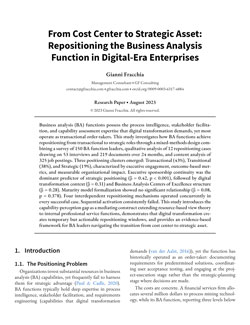
From Cost Center to Strategic Asset: Repositioning the Business Analysis Function in Digital-Era Enterprises
Only 19% of BA functions achieve strategic positioning despite possessing the analytical capabilities digital transformation demands. This study identifies the four mechanisms that enable repositioning and why capability maturity models alone fail to predict strategic positioning.
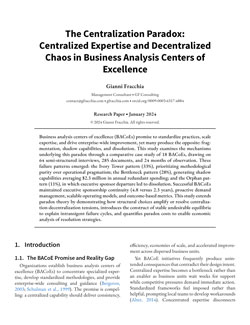
The Centralization Paradox: Centralized Expertise and Decentralized Chaos in Business Analysis Centers of Excellence
BACoEs designed to standardize practices routinely produce the opposite (fragmentation, shadow capabilities, and dissolution). This study documents three distinct failure patterns and quantifies their organizational cost.
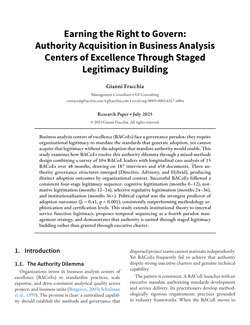
Earning the Right to Govern: Authority Acquisition in Business Analysis Centers of Excellence Through Staged Legitimacy Building
BACoEs cannot mandate standards without legitimacy, yet cannot gain legitimacy without the adoption that mandate authority would enable. This study identifies the four-stage sequence and the rule of one that resolve this authority dilemma.
Project Governance Research
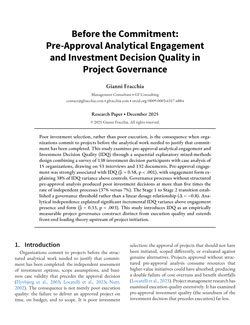
Before the Commitment: Pre-Approval Analytical Engagement and Investment Decision Quality in Project Governance
Organizations approve projects before the analysis needed to justify them exists. This study identifies a governance threshold (not a dosage relationship) separating investment decisions that hold up retrospectively from those that do not.
The Gap Framework Research
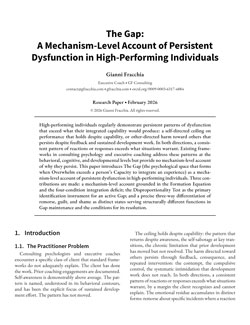
The Gap: A Mechanism-Level Account of Persistent Dysfunction in High-Performing Individuals
A mechanism-level account of persistent dysfunction in high-performing individuals, introducing The Gap as the psychological space that forms when Overwhelm exceeds a person's Capacity to integrate an experience. This paper introduces the Disproportionality Test as a diagnostic instrument for identifying when a reaction signals an unresolved Gap.
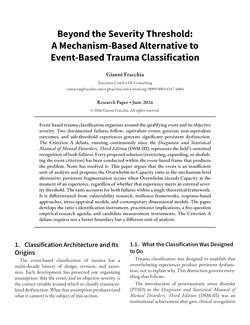
Beyond the Severity Threshold: A Mechanism-Based Alternative to Event-Based Trauma Classification
Event-based trauma classification cannot account for two documented failures: equivalent events produce non-equivalent outcomes, and sub-threshold experiences produce significant persistent dysfunction. This paper proposes the Overwhelm-to-Capacity ratio as a mechanism-level alternative, accounting for both failures within a single theoretical framework.
Related Resources
The Business of Analysis: How to Build, Launch, and Sustain a High-Performance Business Analysis Capability applies the BACoE research findings to practical implementation.
Consulting, Speaking, and Coaching
For consulting, speaking, or coaching engagements informed by this research, visit the Contact page.