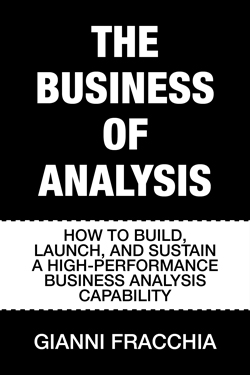
The Business of Analysis: How to Build, Launch, and Sustain a High-Performance Business Analysis Capability
By Gianni Fracchia | D&G Publishing | April 2026 | 334 Pages
Organizations invest millions in projects that technically succeed yet deliver no meaningful business value. The problem is not execution. It is fragmented business analysis that misses real needs, creates expensive rework, and delivers solutions nobody uses.
The Business of Analysis shows how to build a business analysis center of excellence (BACoE) that transforms ad hoc practices into a systematic organizational capability. This is not theory. It is battle-tested guidance for navigating the political realities and organizational dynamics that determine whether BACoEs succeed or become expensive failures.
This is not another book on writing better requirements. The Business of Analysis is the definitive playbook for embedding rigorous business analysis into how an organization naturally works.
Who This Book Is For
This book is written for leaders and practitioners with direct responsibility for business analysis capability:
- BACoE leaders building or running a business analysis center of excellence.
- Senior, principal, and distinguished BAs preparing to launch a systematic capability.
- Executives evaluating whether to invest in a BACoE.
- PMO directors, enterprise architects, and transformation leaders who recognize that business analysis capability is missing from their organizational toolkit.
The Problems This Book Solves
This book addresses the organizational consequences of fragmented business analysis:
- Projects that follow every best practice (requirements workshops, approved user stories, flawless agile ceremonies, and signed user acceptance testing) yet land with 11% adoption three months after go-live.
- Practices that vary by project, team, and assigned personnel, with no shared standards, no validated techniques, and no organizational memory.
- BAs with deep expertise who leave because no career path exists, no community exists, and no recognition exists.
The cumulative cost of these problems does not appear in visible disasters. It accumulates quietly as organizational debt: requirements that capture requests instead of needs, solutions that solve symptoms instead of problems, and initiatives that deliver outputs instead of outcomes. For organizations with significant project portfolios, this cost runs into tens of millions annually.
What This Book Delivers
This book covers the complete BACoE implementation journey:
- From securing executive support through launching operations to sustaining capability over years, grounded in empirical research and lessons from dozens of BACoE implementations, both successes and failures.
- The three foundational pillars that make BACoEs work: standards that create consistency without bureaucracy, capability development that elevates your entire business analysis community, and service delivery that demonstrates tangible value.
- The three-phase maturity model (Project Focus, Enterprise Focus, and Innovation Focus) that maps the BACoE from project-level service delivery to strategic organizational asset, with realistic timelines and readiness indicators for each phase transition.
The book also addresses the questions that keep BACoE leaders awake:
- How do I prove value when benefits are often invisible?
- How do I govern without becoming the bottleneck everyone circumvents?
- How do I build capability when my BAs resist assessment and standardization?
- How do I secure executive sponsorship and maintain it when sponsors change?
- How do I know whether to centralize or federate?
- How do I survive the political warfare with the PMO?
This guidance is principles-based, not prescriptive. A BACoE that works for a 500-person regional bank will fail at a 50,000-person global manufacturer. The frameworks here help you make the correct choices for your specific context.
Organizations that build strong BACoEs do not simply improve project success rates. They make better strategic decisions. They stop building the wrong things. They retain institutional knowledge instead of losing it every time a senior BA leaves. They develop business analysts who think strategically, not just document tactically. The frameworks that enable these outcomes are not drawn from theory or ideal conditions. They are grounded in empirical research.
The Research Foundation
This book is grounded in empirical research across five studies. The underlying research papers are available on the Research and Findings page.